AI-Native Insurance company
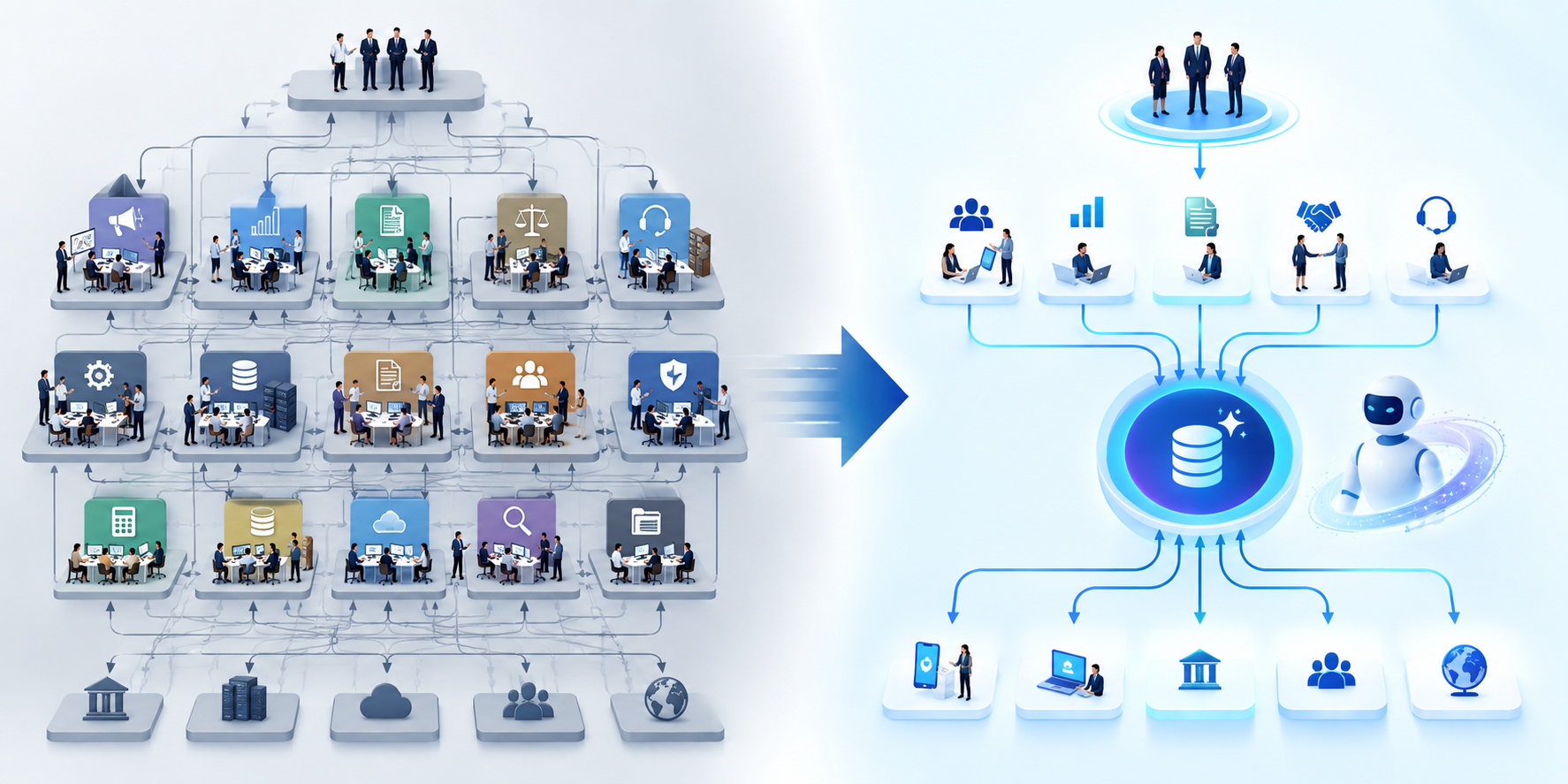
The Next Evolution of Insurance Companies: From Direct to Digital — and Now to AI-Native Insurance company
Over the past few decades, the insurance industry has undergone several major transformations. When the direct insurance model first emerged, it was already clear that technology would change not only the way insurers sell policies, but also the relationship between insurers and their customers - and even the organizational structure of insurance companies themselves.
Then came the digital revolution. Websites, mobile apps, customer portals and self-service processes dramatically changed the way customers and agents interact with insurance companies.
Yet, when looking inside the insurance company itself, a somewhat different picture emerges: the customer interface has changed dramatically, while the operating model behind it has changed far less.
Even in an insurance company that appears fully digital from the outside, a long chain of people still operates behind the scenes, connecting a business need with its actual execution in the system: product managers, business and system analysts, implementation specialists, developers, QA teams, operations and integration professionals.
A product change, the introduction of new coverage, or a change to a business process still often follows a lengthy path: business requirement, analysis and specification, translation into technical requirements, implementation or development, testing and deployment - and only then does the change reach the core system and the digital channels.
It is a long and expensive process, with numerous potential points of failure and delay.
The AI revolution has the potential to change this structure as well.
Not Just AI Making Decisions - But an Insurance Company That Operates Differently
Much of today’s discussion around AI in insurance focuses on decision - making and automation: sales, underwriting, claims handling, fraud detection, pricing, customer service and document analysis.
These are important use cases, but they represent only part of AI’s potential - and not necessarily the part that will drive the most fundamental transformation within insurance companies.
The deeper change may occur when AI becomes an integral part of the core insurance platform itself.
A modern core platform designed for this new environment can - and should - enable, on the one hand, complete business processes with a high degree of automation and AI-driven decision-making, and on the other, create an entirely new interface between the business side of the insurance company and its core system.
Instead of a product manager submitting a requirement to a system analyst, who then translates it into system definitions and technical requirements that are subsequently passed on to implementation specialists, developers and QA teams, an increasing part of this process can be performed through direct, natural-language interaction between the business user and the core platform.
For example:
“I want to launch a new risk insurance product based on Product X, with an entry age of up to 65, three underwriting levels, and a revised pricing structure.” And the possibilities go much further.
Products, agreements, documents and business rules could all be defined and managed in this way — potentially extending even to changes in digital distribution processes through AI-powered development capabilities integrated directly into the core platform.
An AI-powered core platform can understand the business intent, identify the relevant system components, propose the required changes, and execute them within defined authorization, control and testing mechanisms.
The same principle can apply across products, policies, agents, underwriting, claims, pricing, business rules and operational processes.
The AI-Native Insurer Will Also Be a Much Leaner and More Efficient Organization
This may ultimately be the most significant change of all. An AI-native insurer is not simply an existing insurance company with AI tools added on top. Its operating model may be fundamentally different - across customer service, management, operations and information systems.
As the distance between a business decision and its execution within the system becomes shorter, the need for some of the intermediary layers that currently exist between business and technology is reduced as well.
This does not mean that technology professionals, insurance experts, governance or risk management will disappear. Rather, a significant portion of the translation, handoffs and implementation work currently performed between different functions can become automated.
The result could be an insurance company with an operating structure that is tens of percent leaner than that of a traditional insurer handling a comparable volume of business - while at the same time being significantly faster and more agile.
The transformation is therefore not merely about reducing workforce costs. It is about the ability to move from Business Intent to Execution almost directly.
The Core Platform Evolves from an Operational System into an Execution Engine
For this vision to become reality, simply adding an AI layer on top of an existing legacy system is not enough. That approach belonged to the world before the AI revolution. The modern core platform must enable AI to understand and interact with the insurance business model itself: products, policies, agents, underwriting, claims, pricing, business rules and processes.
In this environment, the core platform is no longer simply the system in which an insurance company manages its operations.
It becomes the execution engine of the AI-native insurance company.